
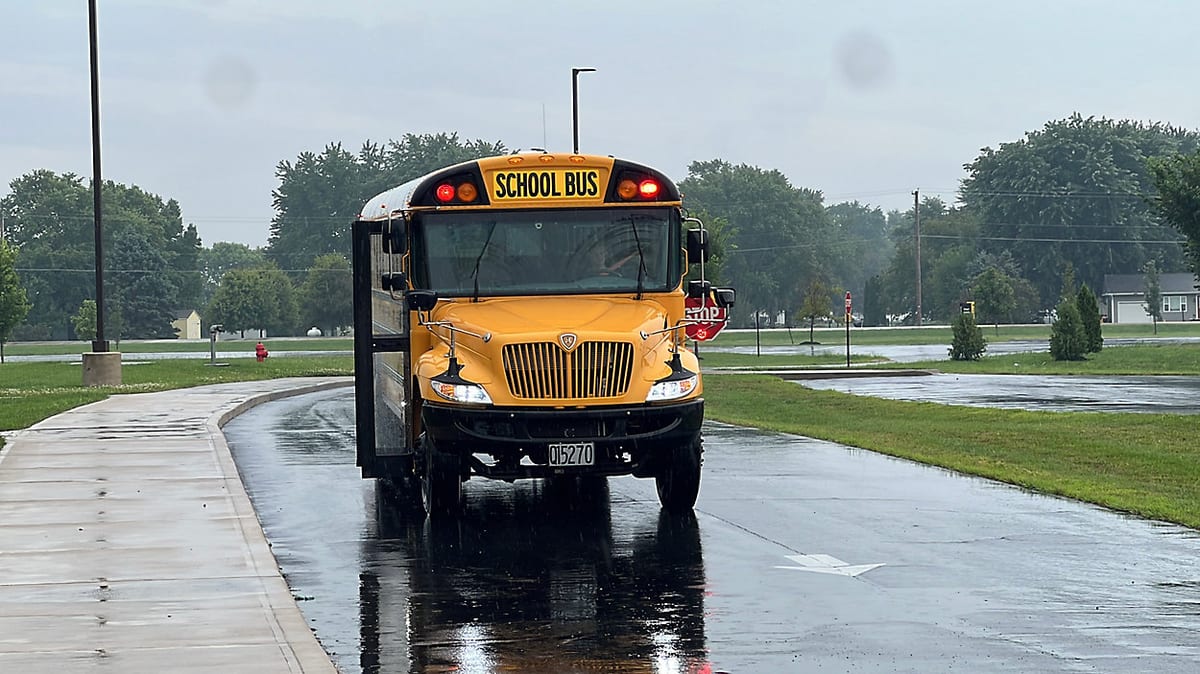
NEW HAVEN, CT — Connecticut’s new road rules take effect Thursday, Oct. 1, raising penalties for some violations and adding a six-month license suspension after a third qualifying school-bus violation.
The measures apply in New Haven and statewide. They are provisions of public acts passed by the Connecticut General Assembly, not proposals awaiting a local vote. The General Assembly’s Office of Legislative Research outlines the effective dates and penalties, and state bill records show the school-bus suspension measure was signed by Gov. Ned Lamont on June 4.
School-bus violations can mean a six-month suspension
Under Public Act 26-95, the motor vehicles commissioner must suspend a driver’s license or operating privilege for six months, without a hearing, after a third or subsequent qualifying violation of the law requiring drivers to stop for a school bus displaying flashing red lights. The suspension applies when the driver is convicted, forfeits a bond or receives a suspended judgment or sentence for the violation.
Drivers must stop at least 10 feet from the front or rear of the bus and remain stopped while its red lights are flashing. The suspension provision adds a license consequence after repeated qualifying violations; it does not replace the state’s existing penalties for passing a stopped bus.
Those state penalties are $450 for a first offense. For a subsequent offense, the penalty is a fine of $500 to $1,000, up to 30 days in prison, or both, according to the legislative summary. The six-month suspension does not apply to violations issued under municipal school-bus camera ordinances.
Travel bans, exhausts and phone use
Public Act 26-63 raises the fine from $50 to $250 when a commercial vehicle ignores a statewide travel ban in severe weather, CT News Junkie reported. The increase concerns those commercial-vehicle violations, not drivers generally. Connecticut DMV Commissioner Tony Guerrera told WFSB that the change followed truck violations during a prior storm and that the existing fine was small. The legislative account says the Department of Transportation requested the increase to discourage vehicles from entering roads during storms and help make cleanup safer for state crews.
The same act doubles the fine for certain motor-vehicle mechanical-equipment violations, including rules concerning mufflers and exhaust pipes, from $150 to $300. A 50% Special Transportation Fund surcharge applies, bringing the total to $450. The law covers specific equipment violations, such as an improper muffler or a device that amplifies vehicle noise. It does not apply simply because someone considers a vehicle loud.
The act also expands the distracted-driving rules. It prohibits holding or supporting a mobile electronic device with any part of the body while driving, and using a mobile electronic device while driving unless it is in hands-free mode. Drivers are also prohibited from reading, viewing or typing messages while driving. The law prohibits driving while a video is visible to the driver in the normal driving position, with exceptions such as GPS and backup-camera displays.
Public Act 26-120 makes prohibited distracted driving in a highway work zone a reckless-driving violation. A driver cannot be prosecuted for both offenses for the same conduct.